
Actionable guide to live football betting: markets, signals and simple trading
Live football betting: what it is and why in‑play matters
Live football betting (in‑play) lets bettors place or trade bets while a match is ongoing. Unlike pre‑match wagers, in‑play markets move fast as events (goals, cards, substitutions) and statistical signals (shots, expected goals) change the probability of outcomes. The opportunity: react to real momentum shifts. The risk: emotional, rapid decisions that hurt bankrolls unless disciplined.
This guide explains the main in‑play markets, how to read live statistical signals such as in‑play xG, shots and dangerous attacks, how odds and liquidity behave, and introduces simple trading actions — cash‑out, hedging and scalping — plus a practical pre‑match to in‑play checklist for disciplined decision‑making.
Key in‑play markets explained (quick reference)
Understanding each market’s mechanics and when it typically moves is the first step in live football betting.
Match result (1X2)
A bet on home win, draw or away win while the game is live. Odds react quickly after big events; a late red card or an expected‑goals swing can shift prices dramatically.
Next goal / Total goals / Over‑Under
Next goal predicts which team scores next (or none). Over/Under (e.g., Over 2.5) is useful when a game becomes open or tight—watch additions of clear chances rather than time alone.
Both Teams To Score (BTTS)
A simple yes/no that reflects whether both teams will register a goal. Live value emerges when one team suddenly starts creating clear chances or the trailing side commits numbers forward.
Asian handicap and Draw No Bet (DNB)
Asian handicap evens out perceived strength differences by giving goals advantage/deficit; DNB removes the draw outcome (stake returned if draw). Both are used to reduce variance when a favorite underperforms early.
Double chance, Correct score and Accumulators
Double chance covers two of three results (greater safety, smaller odds). Correct score offers large odds but is volatile in‑play. Accumulators combine selections; live accumulators are risky because each leg’s uncertainty compounds.
Other live specials (cards, corners, total shots)
Markets like total corners, cards or bookings can offer micro‑opportunities when a match’s style and referee tendencies are understood.
Reading live statistical signals: in‑play xG, shots and dangerous attacks
Stat feeds power better in‑play decisions than raw scoreboard time. Key signals:
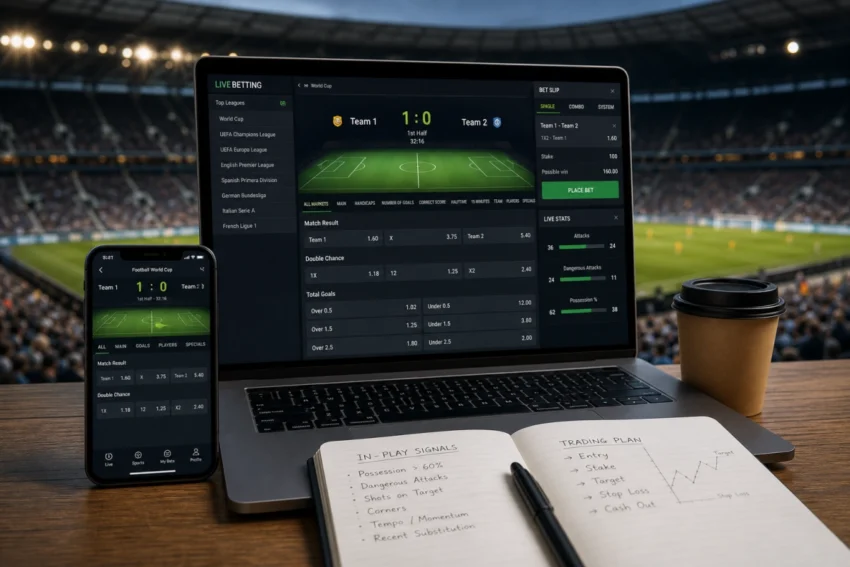
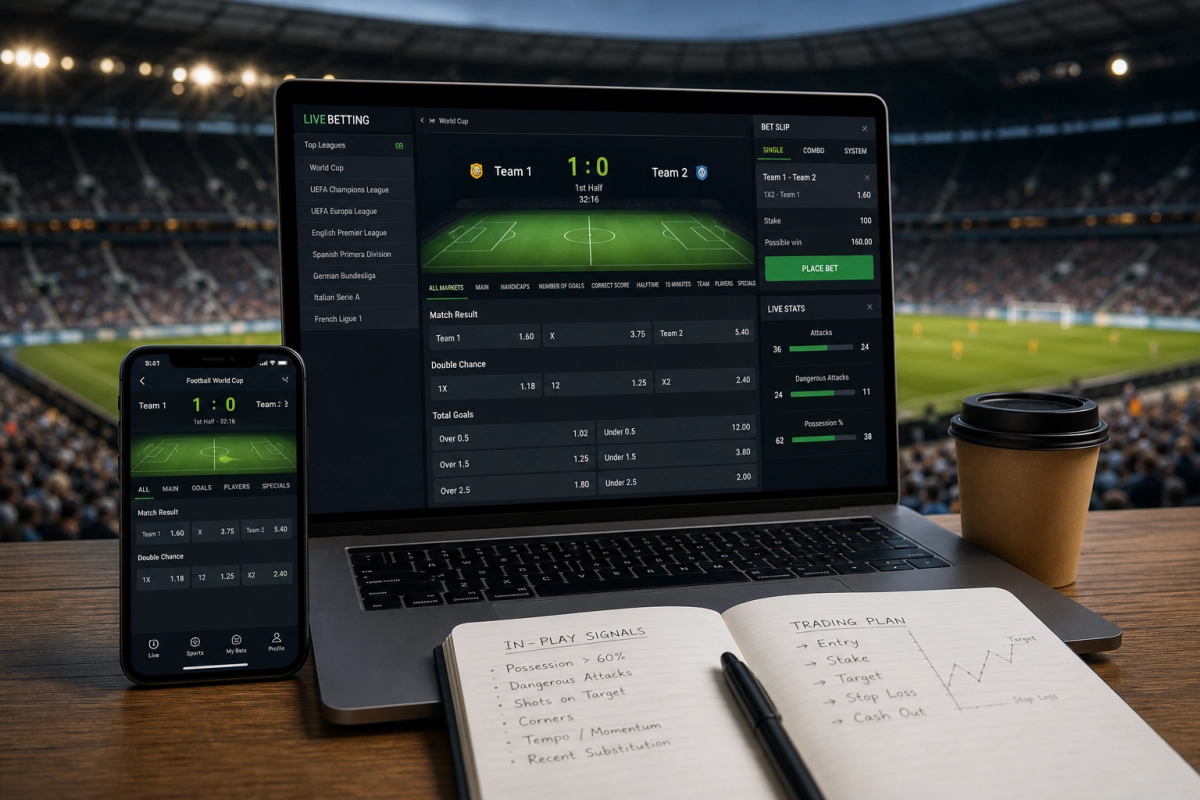
- In‑play xG: measures chance quality. A rising xG for one side over short spells suggests sustained high‑quality chances — odds for that side should shorten. Use it to detect momentum before a goal.
- Shots and shots on target: volume matters, but quality matters more. Many long‑range shots rarely change value; repeated shots from inside the box are stronger signals.
- Dangerous attacks / entries: sequences into the penalty area or key passes indicate real scoring threat and often precede odds movement.
Combine these signals: a team producing high in‑play xG, multiple shots on target and repeated penalty‑area entries is statistically more likely to score soon. Watch how bookmakers’ odds react and whether liquidity (the volume and depth of market) supports quick trading — shallow liquidity can cause volatile swings and wider spreads.
Next, the guide will walk through how to interpret odds movement in real time, assess liquidity, and apply three simple trading techniques (cash‑out, hedging and scalping) step by step, with a practical pre‑match to in‑play checklist for disciplined bankroll control.
Interpreting odds movement and assessing market liquidity in real time
Odds are the market’s voice — they encode probability and sentiment. Learn to translate movement into actionable signals and check liquidity before committing size.
- Convert odds to implied probability: quickly convert decimal odds to percent (1/odds). If a team moves from 2.50 to 2.00, implied probability rises from 40% to 50% — a significant market reassessment.
- Look for directional conviction: small, steady shortening across multiple bookmakers or the exchange suggests sustained momentum (stat signal confirmation). A single sharp drop on one book but not others often means a large individual stake or errant market — beware.
- Watch timing and magnitude: pre‑goal spikes often happen within 10–60 seconds of repeated shots/penalty‑area entries and settle slowly if no goal follows. Fast, large moves late in a match usually reflect scoring events or red cards and may be too volatile to trade unless you’re scalping on an exchange.
- Assess liquidity and spread: on exchanges check available back and lay sizes at best prices; deep markets (large matched amounts) let you enter/exit with minimal slippage. Wide spreads or tiny available amounts mean your bet will move the market — reduce stake or sit out.
- Use cross‑market confirmation: next‑goal, over/under and correct‑score lines often move coherently. If match‑odds shorten but next‑goal stays static, the move may be sentiment rather than real chance creation.
Rule of thumb: only increase stake when statistical signals (in‑play xG, shots on target, penalty‑area entries) and multi‑market odds movement align, and liquidity is sufficient to execute without large price impact.
Simple in‑play trading techniques: cash‑out, hedging and scalping
Three practical, low‑complexity actions let you lock profits or limit losses without advanced tools.
Cash‑out
- What it is: bookmaker offers to settle a pre‑existing bet early for a price. It’s effectively the bookie’s counter‑offer reflecting current market odds and their margin.
- How to use it: accept cash‑out when the offered amount secures a satisfactory risk/reward compared with the chance of reversal. Example: you’re +€30 on a pre‑match €50 back at 3.00; after 70 minutes the bookie offers €20 cash‑out — if remaining risk of conceding outweighs expected value, take it.
Hedging
- What it is: placing an opposing bet (often on an exchange) to reduce exposure and lock profit or limit loss.
- How to use it: simple hedge example — you backed Team A pre‑match at 2.50 (€100). At 60′ Team A leads and is now 1.60. Lay Team A for €156 at 1.60 (stake to profit equalise) to guarantee similar return regardless of final result. Calculate stakes to balance outcomes before placing.
Scalping
- What it is: small, quick trades on exchanges exploiting temporary mispricing or liquidity imbalances.
- How to use it: target 2–5% profits per trade, set limit orders at the best back/lay prices, keep stake proportional to available depth, and use tight time/stop rules. Only scalp in fairly liquid matches (big leagues, popular fixtures).
Across all techniques, predefine profit targets and maximum acceptable loss. Emotional, ad‑hoc decisions are the main cause of erosion in live trading.
Pre‑match to in‑play checklist for disciplined decision‑making and bankroll control
- Pre‑match (30–60 min): final team news, referee, weather, expected style, and target markets. Set a clear plan: back, trade, or watch. Decide unit size (e.g., 1% of bankroll) and max exposure.
- Before placing an in‑play stake: confirm liquidity, check live xG/shot feeds, and list clear triggers that will prompt action (e.g., two inside‑box shots in five minutes, red card).
- During play: stick to your staking rules, use hedges or cash‑outs only per pre‑set rules, and avoid increasing stake after losses. If market noise exceeds your plan, step away — only return when objective signals reappear.
- Post‑match: log the trade: market, stake, odds in/out, reason, outcome and lessons. Maintain a max daily loss (e.g., 5% bankroll) and a cooldown period after breakeven/loss streaks.
Discipline + simple rules turn live opportunities into a repeatable edge. The next part will expand on sizing templates and example trade diaries to build that edge over time.
Simple staking and sizing templates
- Flat units: define 1 unit = 1% of bankroll. Pre‑match/back trades: 1–2 units. In‑play scalps: 0.25–0.5 units per scalp. Max concurrent exposure: 5 units (5% bankroll).
- Scaled risk (conservative): 0.5% base unit. Pre‑match/back trades: 1–3 units based on confidence. In‑play reactive trades: 0.25–1 unit. Stop a market for the day if you hit 5% loss.
- Fractional Kelly (risk‑controlled): calculate full Kelly, then use 10–25% of that fraction to size aggressive edges only. Keep most in‑play activity on flat/unit sizing for predictability.
- Practical caps: never risk >10% of bankroll on a single match across all positions; limit single trade size so poor liquidity won’t move the market (or reduce stake when depth is low).
Example trade diary entry (template + filled example)
- Template fields: Date, Match, Market, Pre‑match position, Unit size, In‑play triggers, Entry odds/time, Exit odds/time/action (cash‑out/hedge/leave), Result, P/L (units), Lesson(s).
-
Filled example:
- Date: 2026‑04‑12
- Match: Swansea vs Barnsley
- Market: Match result (back Swansea pre‑match) and Next goal (in‑play lay)
- Pre‑match position: Back Swansea 2.80, 2 units
- In‑play triggers: Two inside‑box shots & xG spike 0.35 in 8 mins (Swansea)
- Entry odds/time: 15′ Swansea now 1.90 (decided to hedge partial)
- Action: Lay Swansea 1.90, stake sized to lock 1.2 units profit if hold
- Exit/time/result: 68′ Swansea scored; matched lay closed position earlier; net P/L = +1.15 units
- Lesson(s): Signal confirmation (xG + inside‑box shots) justified partial hedge; stick to pre‑defined hedge size to avoid overhedging when liquidity thin.
Putting it into practice
Live football betting rewards preparation, restraint and iteration more than clever tricks. Start small, record every trade, and treat your approach as an experiment: define hypotheses (signals you trust), test them with consistent unit sizing, review results and refine your triggers. Prioritise bankroll protection over chasing quick wins — disciplined limits, liquidity awareness and a simple set of hedging/cash‑out rules will keep you in the game long enough to learn edge‑building patterns. Over time, your best tool will be the trade diary and the patience to follow your own rules.