
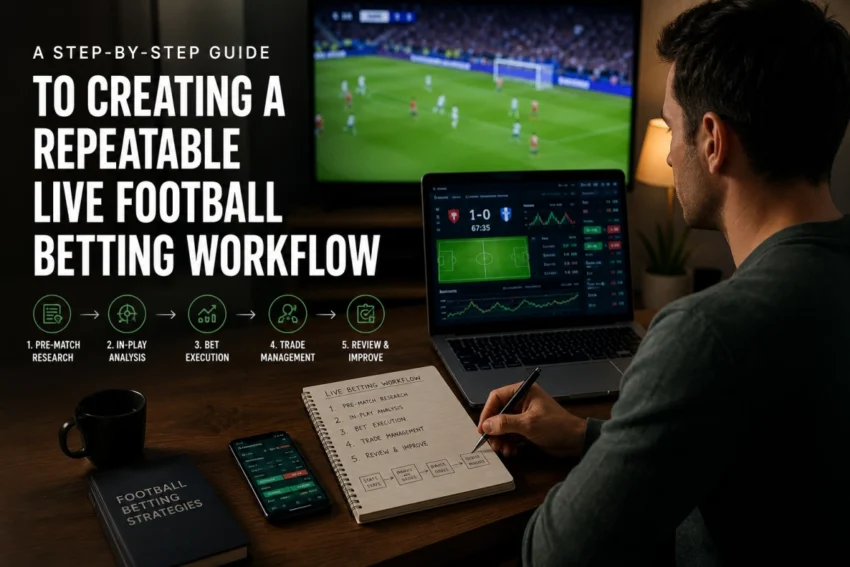
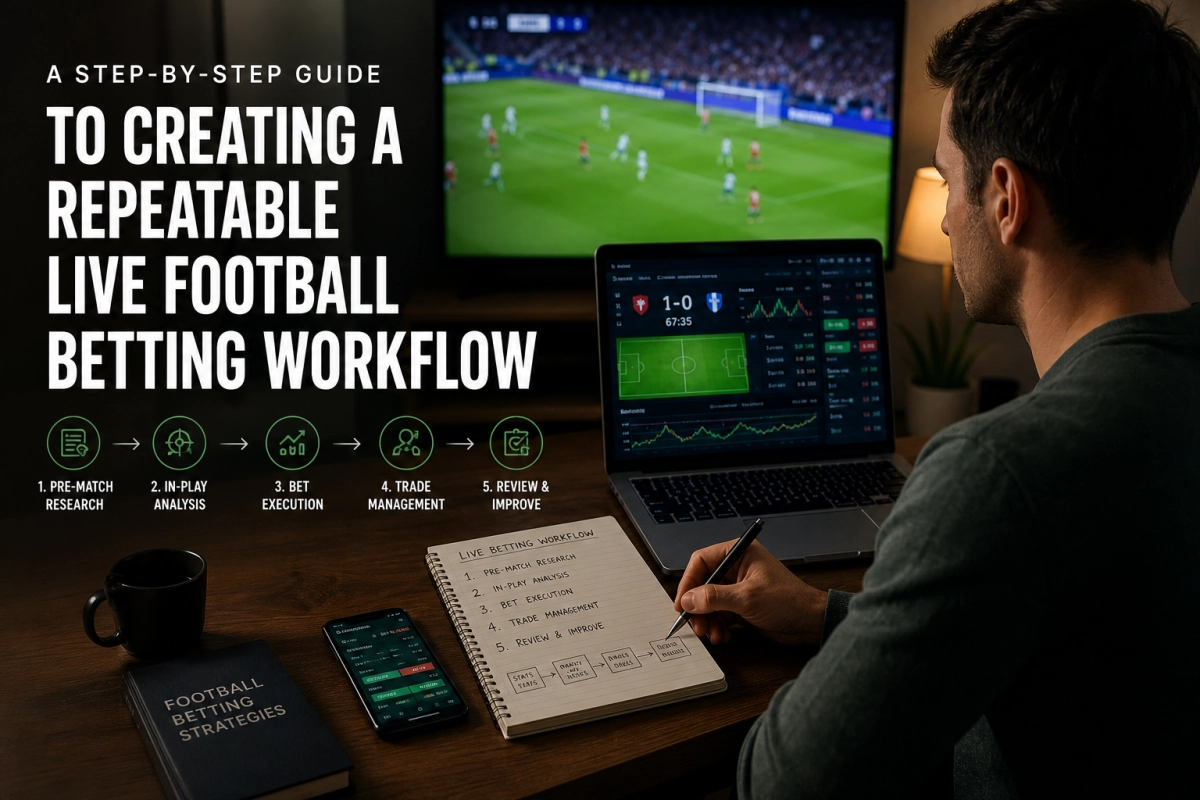
How to build a reliable live football betting workflow
Live football betting rewards preparation and a clear process. Successful in-play decisions come from combining solid pre-match analysis, a small set of trusted markets, quick reading of live match events (shots, possession shifts, substitutions, cards), and disciplined staking and cash‑out rules. This guide begins by explaining what to collect before kickoff and which markets to favour so bettors can act quickly and confidently when the game is live.
Why a repeatable workflow matters for in-play markets
A repeatable workflow reduces emotional shortcuts and speeds decision-making. Instead of reacting to a single event, a workflow gives a checklist: what pre-match signals mattered, what live triggers are relevant, how odds have moved, and what staking or cash‑out rule applies. That consistency helps manage risk and focus on value rather than noise.
- Speed: a fixed checklist avoids hesitation during fast-moving matches.
- Consistency: the same steps mean results are comparable across matches.
- Discipline: predefined staking and cash‑out limits limit losses and lock in gains.
Essential pre-match data to gather before kickoff
Before placing live bets, gather a short, structured dossier for each match. Keep it compact so it’s usable in-play.
- Recent team form: last 5–8 matches, scoring and conceding trends.
- Home/away splits: some teams change profile away from home.
- Injuries and suspensions: key absences that change tactics or set-piece threat.
- Expected lineups and tactical setup: formations, press intensity, wing use.
- Motivation and context: cup vs league, relegation pressure, squad rotation.
- Weather/pitch: heavy pitch can reduce goals; wind affects set pieces.
- Pre-match odds and market movement: initial price, early money, and sharp shifts.
Quick primer on common betting markets
Understand markets you’ll trade live so you can move from observation to action:
- Match result: 1X2 — win, draw, lose.
- Double chance: covers two of three outcomes (e.g., home or draw).
- Draw no bet: stakes refunded if the match draws, reduces risk.
- Both teams to score (BTTS): yes/no on both sides scoring.
- Over/Under goals: total goals thresholds (e.g., over 2.5).
- Asian handicap: evens out imbalanced matches with goal handicaps.
- Correct score: high variance, low probability specific scorelines.
- Accumulators: multiple selections; high risk/reward — usually avoided live unless very selective.
- Live betting: markets that update with events — requires fast, informed moves.
Having this foundation in place before kickoff makes in-play reactions faster and more measured. The next section explains how to monitor and interpret live events (shots, possession shifts, substitutions, cards), read odds movement in real time and apply strict staking and cash‑out rules to execute your workflow.
Monitoring and interpreting live match events: what to watch and when it matters
Live data is noisy; the value comes from consistent interpretation. Treat each event as a signal with weight, not a trigger on its own. Build a short checklist of event types and clear thresholds that convert observation into action.
– Shots and shots on target: track shot volume and quality over short windows (e.g., 10–15 minutes). A sequence like 3+ shots with 1+ on target inside 10 minutes from one side suggests sustained pressure; 2–3 shots from inside the box raises the probability of an imminent goal more than speculative long-range attempts. Wherever possible use live xG or estimated shot quality — a visible jump in cumulative xG for one side is a higher‑value signal.
– Possession and territory shifts: raw possession % is slow; instead watch progressive passes, entries into the final third, or repeated corners. Define a territory-trigger (e.g., three successive entries / final‑third possessions within 6 minutes) as meaningful momentum.
– Counterattacks and transitions: some teams concede when exposed on counters. Log the context — a team dominating possession but struggling to contain counters may still be vulnerable; a quick breakaway with a shot on target deserves more weight than possession dominance.
– Set-pieces and defensive frailties: repeated corners, free-kicks around the box, or a centre-back shown to be losing aerial duels are red flags for goals from dead-ball situations. If a key defender is booked early, increase expected concession probability.
– Substitutions and tactical changes: classify subs into attacking, defensive, or neutral. An attacking sub for a trailing team after 60 minutes should raise the chance of goals; a defensive full-back replaced by a midfielder suggests a shift to containment. Keep a simple mapping in your dossier so you can translate a sub into a numeric adjustment to your expectation (e.g., +0.15 xG/15min).
– Cards and injuries: a red card or a visibly hampered player changes value immediately. Predefine rules: one red card to the favourite = reduce favourite match-winner stake by X% or close position, depending on market and time remaining.
Convert these signals into action with a short live decision matrix: list the event, its weight (low/medium/high), the markets to consider (e.g., 1X2, Over/Under, BTTS, next-goal), and the default stance (enter/hold/exit). That reduces hesitation and overreaction.
Reading odds movement and combining market signals with match context
Odds are real-time aggregations of market belief and liquidity flow — treat them as a sensor. Your job is to distinguish informative moves (sharp money, sustainable drift) from noise (bookmaker risk management, low-liquidity blips).
– Watch implied probability and line drift: convert odds into implied probability and compare to your in-play expectation. If the live price for “home win” shortens by 30% in implied probability after a sustained attack sequence, that may be a value signal if your model already expected higher probability.
– Identify steam moves vs gradual shifts: a sudden, sharp price change across multiple bookmakers or the exchange often reflects professional money and is worth investigating. If the move matches live events (e.g., a flurry of big chances), it is more credible. If it’s a lone bookmaker adjusting with no event, suspect liability management.
– Use liquidity to size bets: on exchanges, larger available volume at price points gives you confidence to place bigger stakes. Thin markets deserve smaller, conservative sizing.
– Correlate event weight with market movement: require market confirmation for medium-weight events. For example, a single shot on target (low weight) shouldn’t prompt a trade unless odds shorten meaningfully or volume increases. For high-weight events (red card, multiple high-xG shots), act even if market moves modestly.
– Avoid chasing volatility: if odds swing wildly without corresponding match context, abstain. Trading against panicked public money can be profitable, but only if you have the discipline and liquidity to do so.
Finally, always timestamp notes: when an event occurs, note minute, event, and odds. That creates a short audit trail so you can evaluate whether similar future moves should be traded the same way.
Disciplined staking and cash‑out rules for faster, consistent execution
Your staking model must be simple and automated in decision terms so you can act quickly under pressure.
– Fixed-risk unit: risk a small, fixed percentage of bankroll per live trade (e.g., 0.5–1%). This prevents oversized exposure when markets move fast.
– Confidence multiplier: predefine three confidence bands (low ×1, medium ×2, high ×3) that adjust the unit size based on your live decision matrix weight and market confirmation.
– Predefine stop-loss rules: set maximum loss per match (e.g., 4–6% of bankroll) and per trade (the unit). If hit, close the book and refrain from further live trades on that game.
– Partial cash-out heuristics: lock profits when the market moves in your direction by a certain amount (e.g., odds shorten to deliver a 40–50% expected ROI if cashed now). Alternatively, take a partial hedge to secure a portion of profit while leaving some exposure.
– Forced-exit triggers: list events that automatically close or reduce positions (red card to opposing team, sending off of your backed side, major injury, or a substitution that neutralises the edge).
Practice these rules in small stakes or on a simulator until execution becomes instinctive. A clear, pre-set staking and cash‑out framework cuts emotion, speeds decisions, and ensures you treat in-play trades as a repeatable system rather than ad‑hoc bets.
Putting the workflow into practice
Building a reliable in-play system is less about finding single “perfect” signals and more about repeating a clear process until its strengths and limits are known. Start deliberately, act small, and treat each match as data for the system rather than an emotional event. Consistent recordkeeping, scheduled review, and adherence to pre-set staking and exit rules are what convert an idea into a durable edge.
Immediate next steps
- Create a compact pre-match dossier template you can populate quickly (form, lineups, motivation, key absences).
- Draft a one-page live decision matrix mapping event weights to markets and confidence multipliers.
- Lock in a simple staking rule (unit size and three confidence bands) and a max-loss-per-match limit you will not exceed.
- Run a low-stakes pilot (or simulator) for a fixed number of matches (e.g., 30–50) to build a small, objective sample before scaling.
Post-match review checklist
- Timestamp key events and the odds at the time you acted; note whether the decision matched your matrix.
- Record P/L per trade and per match, including cash-outs and hedges.
- Log rule deviations and emotional/operational causes (late reaction, misread sub, rushed sizing).
- Track performance metrics each week: ROI, strike rate, average odds taken, average hold time, and max drawdown.
- Adjust one variable at a time (event weighting, confidence multiplier, or stop rule) and retest before broad changes.
When to pause, iterate or scale
- Pause trading on a competition or style of match if you hit the pre-defined loss limit or observe systematic mistakes.
- Iterate the decision matrix when patterns in your reviews show consistent mispricing or misclassification of events.
- Scale sizing gradually only after a sustained run that meets your performance thresholds and maintains acceptable volatility.
Consistency, measurement, and controlled experimentation are the practical levers that turn observations into repeatable decisions. Keep the workflow lean, enforce the rules you set, and let incremental improvements compound over time.