

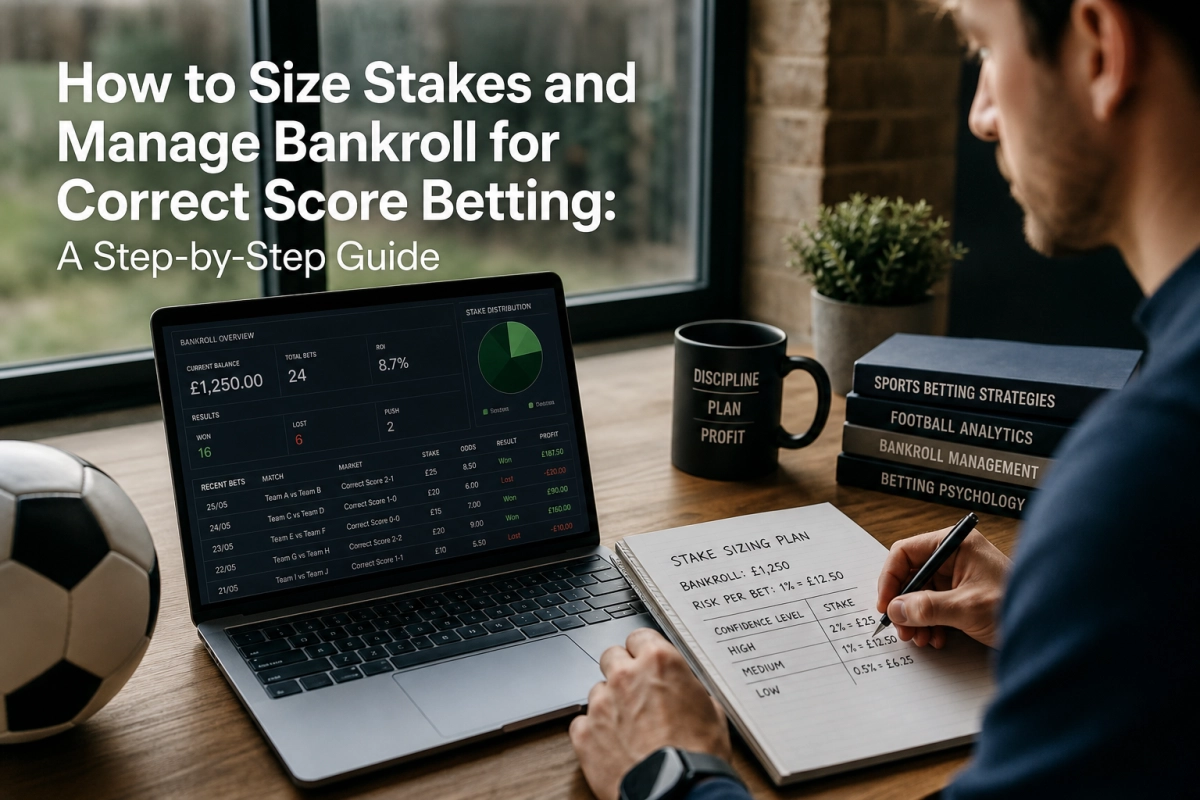
Practical bankroll and stake-sizing for correct score betting
Correct score betting is attractive because of its high odds, but that also means high variance. This guide explains how to size stakes and manage a bankroll for correct score bets in a step‑by‑-step, actionable way. It covers why correct score markets swing wildly, compares common staking systems (flat staking, unit sizing, proportional staking and Kelly), shows how to set exposure limits and maximum drawdowns, and offers simple record‑keeping checklists and rules for when to avoid the market.
Why correct score markets have far higher variance than match result markets
Correct score betting asks for the exact final scoreline (e.g., 1‑0, 2‑1, 0‑0). Unlike match result (home/draw/away) or over/under markets, correct score markets multiply two layers of uncertainty — both the number of goals and which team scores them. Small events (a single goal, a red card, a late penalty) can turn a long‑odds winning selection into a loss.
- Higher payout per winner, lower hit rate — wins are rarer but more profitable when they occur.
- Odds are sensitive to late news and in‑play dynamics; liquidity is often thin, meaning prices move unpredictably.
- Variance compounds across bets: even a positive expected value strategy can experience long losing runs.
Because of these traits, bankroll management is essential. Treat correct score bets as higher‑volatility holdings within a broader betting portfolio and size stakes accordingly.
Staking systems compared — how to choose a method and example sizes
Below are four practical staking approaches. Each has benefits and trade‑offs; choose one consistent method and document it.
Flat staking
Stake the same amount on every bet (e.g., £10). Simplicity and predictable losses make flat staking suitable for beginners, but it ignores differences in edge across opportunities.
Unit sizing (fixed unit)
Define a bankroll unit (for example 1% of bankroll = £10 on a £1,000 bankroll). Stake whole units per bet (1–5 units) depending on conviction. Unit sizing balances consistency with scalable exposure to confidence.
Proportional staking
Stake a fixed percentage of current bankroll each bet (e.g., 1%). The stake automatically adjusts with wins and losses, limiting drawdown but reducing stake growth during winning streaks.
Kelly (and fractional Kelly)
Kelly sizing uses estimated edge and odds to compute an optimal fraction of bankroll. It can maximize long‑term growth but is sensitive to edge estimation errors and yields large variance. Many bettors use fractional Kelly (e.g., half‑Kelly) or cap Kelly outputs to reduce volatility.
Example (illustrative): with a £1,000 bankroll, common conservative choices are flat £10 stakes, 1% proportional staking (£10), or 0.5%–2% exposure per bet depending on confidence. If Kelly suggests 7%, many bettors cap it at 2% or use half‑Kelly to avoid large swings.
Setting exposure limits and maximum drawdowns
- Maximum stake per single correct score selection: cap at 2–5% of bankroll (adjustable to risk appetite).
- Maximum concurrent exposure (all open correct score positions): cap at 5–10% of bankroll.
- Maximum permitted drawdown before pausing strategy: commonly 20–30% (decide and document before betting).
Record‑keeping checklist
- Date, competition and fixture
- Market (correct score) and selection
- Stake, odds, bookmaker/exchange
- Expected edge or rationale
- Result, payout and running bankroll
- Notes (line movement, injury news, liquidity)
When to avoid correct score markets
- Thin liquidity or large bookmaker limits that prevent sensible staking
- Heavy last‑minute team news or doubtful starting lineups
- Matches with high random volatility where analysis cannot credibly estimate edge
- If current drawdown has breached your documented limit — pause and review
With these foundations in place — variance awareness, a chosen staking method, exposure caps and an active record‑keeping habit — the next section will show how to hedge partial positions, use cash‑out strategically and integrate correct score bets into a broader portfolio while keeping responsible gambling practices at the core.
Simple hedging and partial cash‑out techniques (with worked examples)
Hedging is the practical tool for reducing downside after a correct score position has moved in your favour. Two common methods are (A) laying the selection on an exchange and (B) using a bookmaker cash‑out. Both have trade‑offs (commission, price, liquidity). Below are clear, repeatable steps and an example formula you can use in‑play.
How to fully hedge (lay) to guarantee the same profit either way
– Notation: Sb = original back stake, Ob = original back odds (decimal), Ol = in‑play lay odds (decimal), Sl = lay stake.
– Formula for a full hedge that gives identical profit whether your scoreline wins or loses: Sl = (Sb × Ob) / Ol.
– Example: Bankroll £1,000, Sb = £10 on 2‑1 at Ob = 9.0. Later you can lay at Ol = 2.0. Sl = (10 × 9) / 2 = £45. Lay liability = 45 × (2.0−1) = £45. If 2‑1 wins, profit = 10×(9−1) − 45 = £35. If it loses, lay wins 45 − 10 = £35. Locked profit = £35 (ignore commission).
Partial hedge / partial cash‑out
– If full lay is too large or liquidity is thin, hedge a fraction f of the full lay (e.g., f = 0.5). Lay Sl_partial = f × Sl_full. This reduces variance while still locking some profit or reducing potential loss.
– Example continuing above: f = 0.5 → Sl_partial = £22.50. Outcomes: if backed score wins your net is reduced but positive; if it loses your loss is capped by the partial lay. Compute expected position before acting to ensure it meets your risk limits.
Cash‑out vs exchange lay checklist
– Compare cash‑out value (bookie) vs expected profits from a lay after commission. Choose the higher guaranteed return after fees.
– Check liquidity and minimum lay increments; if you can’t match the required lay stake, prefer partial lay or cash‑out.
– Avoid hedging if commission or spreads erase expected value, if the time left makes a turnaround unlikely (e.g., 1–2 minutes), or if hedging would exceed your exposure caps.
Hedging record entry (add to your log)
– Time, current score, minutes, offered cash‑out, lay odds and stake, commission, guaranteed profit or reduced risk, reason for hedging.
Integrating correct score bets into a broader portfolio and keeping gambling responsible
Treat correct score betting as a high‑volatility sleeve within your overall betting portfolio. Practical rules:
– Portfolio allocation: limit correct‑score strategy to a fixed portion of bankroll (e.g., 5–15%). This constrains tail risk while allowing growth potential.
– Correlation awareness: correct score bets often correlate poorly with straight match‑result bets. Use this to diversify, not to overweight risk.
– Rebalancing: after large wins or drawdowns, reset unit size relative to your new bankroll and re‑apply exposure caps (max single stake, concurrent exposure).
Responsible gambling rules to enforce
– Pre‑declare maximum drawdown (e.g., 20%) and a pause condition (cool‑off 7–14 days) if hit.
– Use deposit, stake and session time limits provided by operators.
– Separate entertainment budget: only risk disposable income and never chase losses by increasing stakes.
– Keep behaviour and financial logs; if betting causes stress or impairment, use self‑exclusion tools and seek support.
Practical portfolio checklist
– % of bankroll assigned to correct score strategy
– Chosen staking method and unit size
– Exposure caps (single & concurrent)
– Drawdown stop rules and cooling‑off procedures
– Hedging rules and fee thresholds
Following these rules keeps correct‑score activity disciplined and compatible with longer‑term bankroll health.
A practical 7-step implementation plan
1. Set your boundaries
- Decide total bankroll and % allocated to correct‑score strategy (recommended 5–15%).
- Choose a conservative starting allocation: e.g., 10% of bankroll to correct‑score activity.
2. Choose and document a staking method
- Pick one primary method (unit sizing, proportional or fractional Kelly) and record the parameters (unit size, % per bet, Kelly fraction or cap).
- Example starter settings: unit = 1% of bankroll; max single stake cap = 2% of bankroll; max concurrent exposure = 8%.
3. Implement exposure and drawdown rules
- Set single‑bet and concurrent exposure caps before you start (e.g., single 2%, concurrent 8%).
- Set a hard drawdown stop (commonly 20–30%). If reached, pause for a cooling‑off period (7–14 days) and review.
4. Use the pre‑bet checklist
- Confirm liquidity and available stakes at acceptable odds.
- Check team news, late changes and referee/fixture factors that materially increase randomness.
- Estimate your edge or conviction level and translate it into units or % stake per your method.
- Do not bet if the edge is unclear or limits/odds are sub‑optimal.
5. Record every action
- Maintain the log fields: date, fixture, market, selection, stake, odds, rationale/edge, bookmaker/exchange, result, running bankroll, notes.
- Also log hedges/cash‑outs with time, scoreline and guaranteed P/L after fees.
6. Apply hedging and cash‑out rules in‑play
- Only hedge when the guaranteed profit (after commission and fees) meets your hedging threshold or when reducing exposure falls within your caps.
- Prefer partial hedges if full lay exceeds liquidity or your exposure limits; compute the expected net position before placing the hedge.
- Compare exchange lay vs bookmaker cash‑out and choose the option with the better guaranteed return after fees.
7. Review and rebalance regularly
- Weekly: update bankroll, adjust unit size if using unit or proportional staking, and check that exposure caps still fit your current bankroll.
- Monthly or after a significant drawdown: review strategy performance, edge estimation methods and whether to pause or change approach.
Final notes on disciplined correct‑score betting
Correct‑score markets reward discipline more than intuition. Given the high variance, your single biggest edge is how consistently you follow predefined staking, exposure and stop‑loss rules rather than chasing occasional big wins. Treat each bet as part of a portfolio, keep meticulous records, and be willing to pause and reassess when your rules tell you to.
Above all, preserve your wellbeing: stake only what you can afford to lose, use operator safeguards, and prioritise responsible gambling. With clear limits, a reproducible process and regular review, you can engage with correct‑score betting in a controlled, measurable way that protects bankroll and mental resilience.