
Practical in-play indicators every live football betting fan should watch
Why monitoring in-play indicators improves live football betting decisions
Live betting rewards faster, clearer reading of on-field shifts than the market. Indicators such as xG flow, shots on target, possession momentum and corners reveal real-time changes in dominance, tactics and probability—information that commonly affects match result, over/under, both teams to score (BTTS), Asian handicap, corners and correct-score markets.
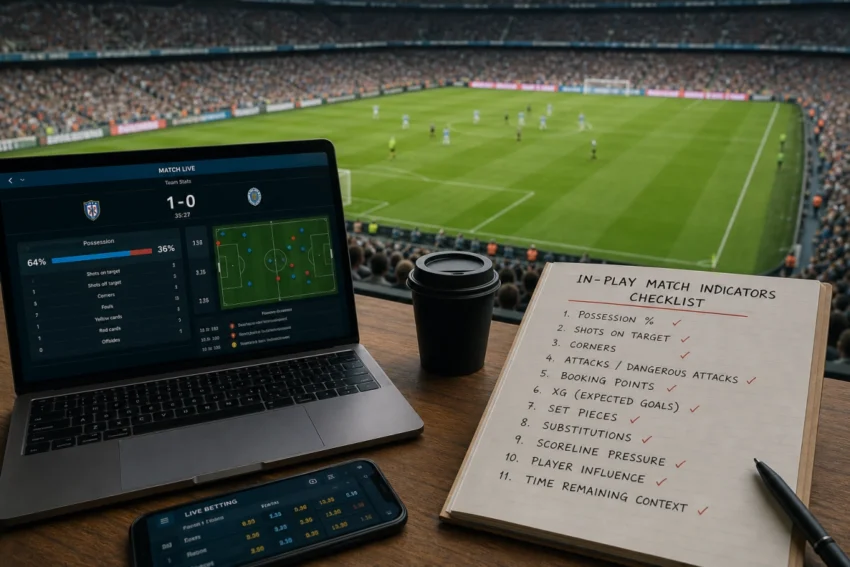
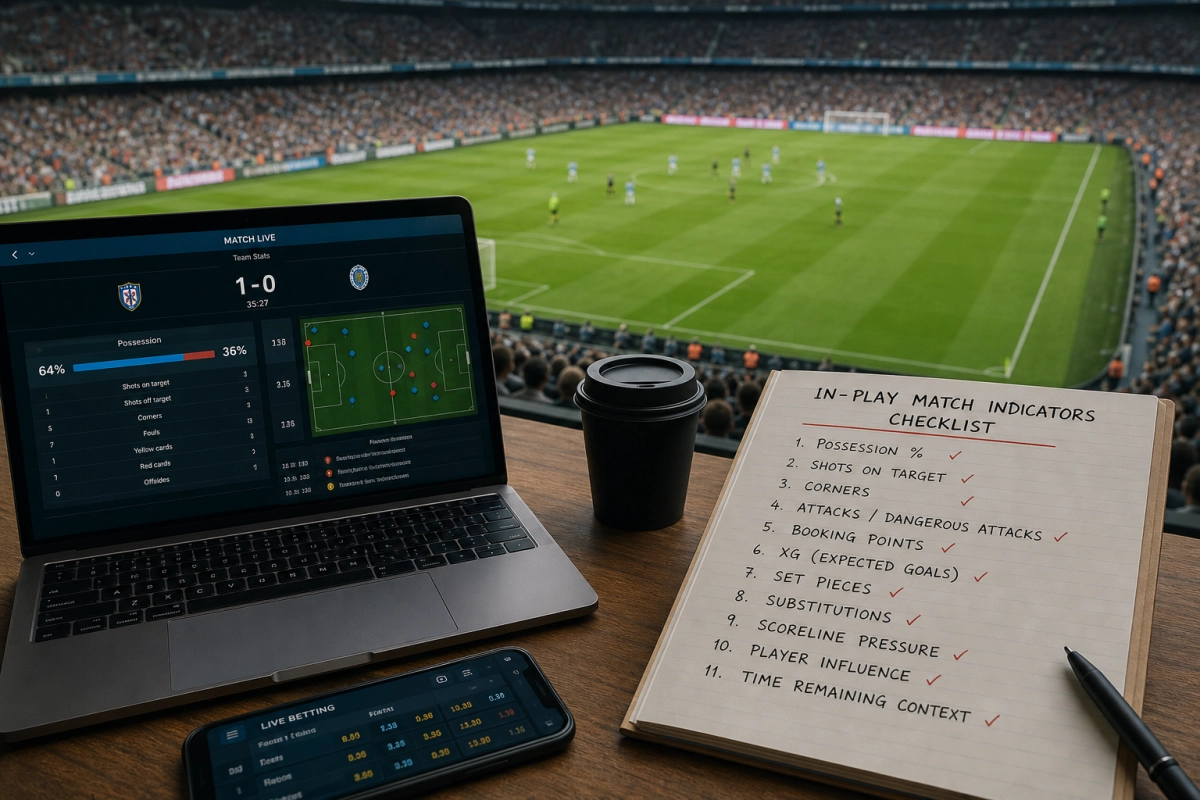
Indicators are signals, not certainties. Combined with simple decision rules and risk controls (small staking, stop-loss limits, partial cash-outs), they help convert observations into disciplined live bets. Below are the core indicators from a practical checklist, each condensed for quick in-play use.
Live football betting essentials: xG flow
Why it matters
xG flow tracks the quality of chances over time; sustained high-xG sequences usually indicate an increased short-term scoring probability beyond raw shot counts.
How to monitor quickly
- Use live xG charts or a running total by half; watch for sustained spikes or a 10–20 minute advantage and note central-area chances versus long-range attempts.
Markets influenced
Match result, over/under (esp. 1.5/2.5), BTTS, correct score and Asian handicap.
Decision rules & risk controls
- Rule: A team with ≈+0.40 xG in 15 minutes can merit a small stake on them to score next or on over 1.5 if before 60′. Risk: limit stake size and set short time targets for cash-out or stop-loss.
Shots on target and shot quality
Why it matters
Shots on target (SOT) combine volume and end-product pressure; clusters of SOTs often indicate a goal is likely despite mixed xG.
How to monitor quickly
- Watch SOT count and type (headers vs open play); multiple SOTs in a short span is high-alert.
Markets influenced
Over/under, BTTS, match result and correct score.
Decision rules & risk controls
- Rule: Two+ SOTs inside five minutes increases goal probability—consider small over/under or next-goal bets. Risk: prefer markets with cash-out and avoid heavy stakes after one spike.
Possession momentum and territorial control
Why it matters
Extended possession in the attacking third elevates scoring chances and signals tactical dominance or opponent fatigue.
How to monitor quickly
- Follow live possession, attacking-third entries and sequences ending in a shot or set-piece.
Markets influenced
Match result, Asian handicap, over/under and corners.
Decision rules & risk controls
- Rule: >65% possession for 10+ minutes with box entries can justify a small Asian-handicap or match-outcome stake. Risk: watch counterattacks—reduce size if opponent converts low-volume chances.
Corners as a proxy for sustained pressure
Why it matters
Corners often follow sustained attacks, raise set-piece scoring chances, and indicate territorial control even when shots are scarce.
How to monitor quickly
- Track corner frequency and clustering; multiple corners in short time commonly precede clear chances.
Markets influenced
Corners totals and Asian corners, plus indirect effects on match result and BTTS.
Decision rules & risk controls
- Rule: 3+ corners in five minutes suggests backing the next-corner or higher corners total with a small stake. Risk: corners are noisy—use low stakes and avoid long-shot accumulators.
Substitutions: tactical shifts and momentum
Why it matters
Subs alter dynamics—attacking changes raise scoring chances, defensive subs stall momentum. The player’s role and timing matter most.
How to monitor quickly
- Note the position changed and whether the sub signals a formation or role shift; attacking subs late increase late-goal probability if intent already exists.
Markets influenced
Match result, over/under, BTTS and next-goal markets.
Decision rules & risk controls
- Rule: An attacking sub mid/late-game can justify a small stake on late goals or over 2.5 if other indicators align. Risk: avoid betting on neutral like-for-like subs; wait for immediate follow-up pressure.
(The guide continues with core situational indicators useful for short-term in-play reads.)
Cards and disciplinary events
Why it matters
Yellow and red cards shift balance—reds force tactical changes and usually increase opponent scoring chances; multiple bookings can change stoppage time and set-piece count.
How to monitor quickly
- Track booked players and referee leniency early; note if key defenders or central midfielders are cautioned.
Markets influenced
Match result, Asian handicap, over/under (extra time), BTTS, correct score and cards markets.
Decision rules & risk controls
- Rule: A red to a key defender suggests a small stake on the opposition (match result/Asian +0.5) or over 1.5 remaining goals if time and momentum allow. Risk: reduce size after a red; volatility spikes immediately.
Pressing intensity and turnover pressure
Why it matters
High pressing creates final-third turnovers and high-quality chances; conversely, a team under pressure will produce rushed clearances and mistakes.
How to monitor quickly
- Look for repeated regains in the final third, intercepted goalkeeper distribution and opponent errors near their box.
Markets influenced
Over/under, BTTS, next-goal, match result and corners.
Decision rules & risk controls
- Rule: 3+ high-third turnovers in ~12 minutes supports small over 1.5 or next-goal stakes. Risk: limit the time horizon (10–15 minutes) for expected payoff and cash out if pressure eases.
Player fatigue and visible energy drops
Why it matters
Fatigue slows reactions, causes positional lapses and increases conceding risk late. Teams with congested schedules or visibly tired key players are vulnerable.
How to monitor quickly
- Watch sprint frequency, recovery speed, misplaced passes and substitutions for physical reasons.
Markets influenced
Match result, over/under (late goals), Asian handicap, correct score and live player props.
Decision rules & risk controls
- Rule: Clear fatigue after 60′ favours small stakes on late goals or the fresher team in Asian markets. Risk: combine with objective markers and keep stakes conservative—fatigue can be masked by fouls/time-wasting.
Scoreboard pressure (scoreline and time-dependent behaviour)
Why it matters
Score and time change behavior: trailing teams take risks and push players forward; leading teams often sit deeper. This alters chance types and frequency.
How to monitor quickly
- Always note score and minute, and watch for chasing teams increasing crosses, long balls or attacking subs.
Markets influenced
Match result, next-goal, over/under (late goals), BTTS, Asian handicap and correct score.
Decision rules & risk controls
- Rule: A team trailing after 75′ that increases attacking intent can justify a small next-goal or over 1.5 bet if other indicators (xG, SOT, corners) support it. Conversely, a team protecting a lead may justify under/low-scoring plays. Risk: reduce stake as time dwindles and combine signals before larger bets.
Weather and pitch conditions
Why it matters
Rain, wind or a heavy pitch changes play quality—reducing passing, increasing errors, and favouring direct play or aerial duels; conditions alter set-piece and finishing probabilities.
How to monitor quickly
- Use live cameras/commentary for surface behaviour and watch whether teams shift to long balls or avoid through-midfield play.
Markets influenced
Over/under (often lower in heavy conditions), BTTS, corners, match result and player props.
Decision rules & risk controls
- Rule: If the pitch is heavy and build-up breaks down, tighten size on overs or favour unders; give 5–10 minutes after abrupt weather changes to see adaptation. Risk: reduce stakes and avoid complex combos relying on technical play.
Live-odds movement and market signals
Why it matters
Odds reflect collective market intelligence—sharp moves can indicate fast data, professional money or insider info. Watching odds helps avoid being on the wrong side of momentum and times entry/exit.
How to monitor quickly
- Watch multiple bookmaker prices or an odds ladder and note sudden shortening/drifting without on-field cause; check traded volume where available.
Markets influenced
All markets—especially match result, next-goal, over/under, Asian handicap and correct score.
Decision rules & risk controls
- Rule: If odds shorten without on-field support, wait for confirmation (shot, corner, sub) before backing; if odds drift while chances are created, consider a cautious value back. Risk: predefine price bands, limit exposure on low-liquidity markets and be wary of frozen lines.
Putting the checklist to work
Treat this checklist as a toolbox, not a guarantee. Combine two or more indicators before increasing stake size, keep strict bankroll rules, log every trade and review outcomes to refine timing and thresholds. Start small, iterate on decision rules, and prioritise protective measures—stop-losses, partial cash-outs and conservative stake fractions—to preserve capital while you learn to read live signals reliably.