
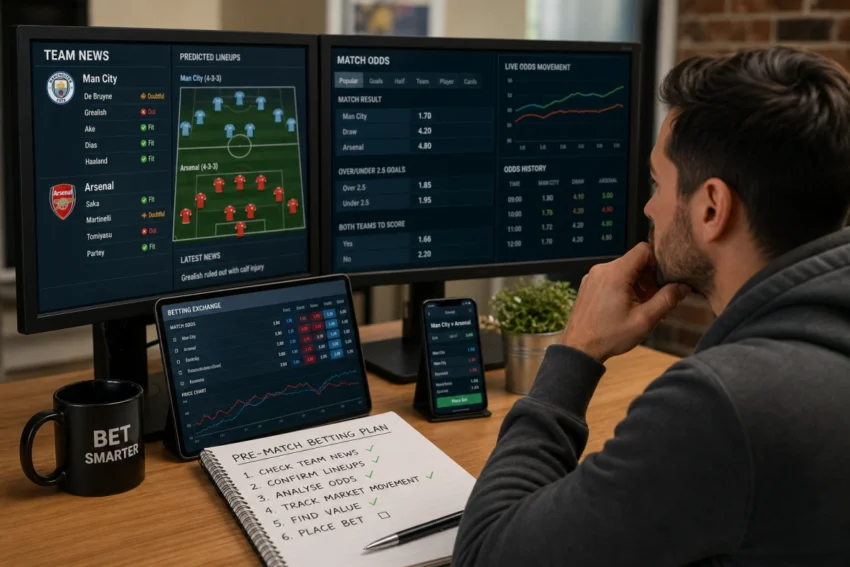
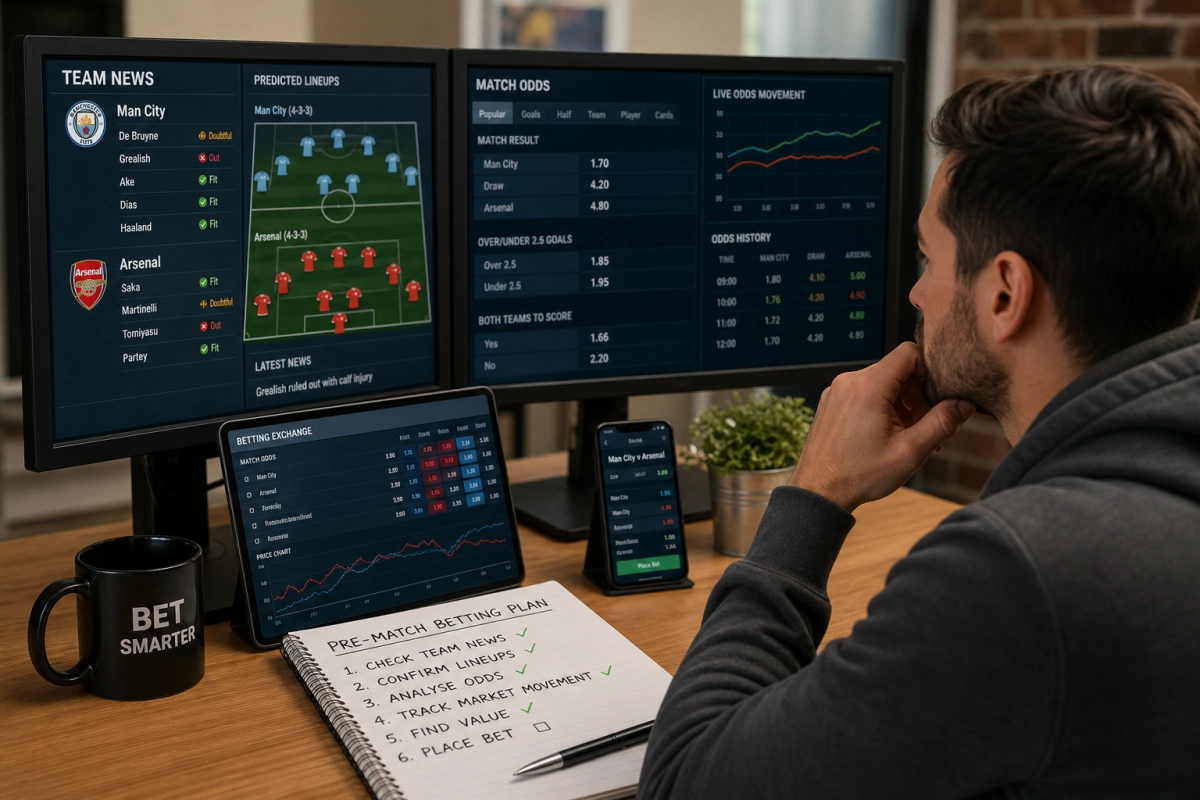
How to approach football pre match betting with team news, lineups and market signals
Football pre match betting rewards preparation. By tracking team‑news windows, probable starting lineups, injuries and tactical clues, bettors can spot shifts in risk and identify value before kickoff. This guide explains where to look, what to read, and how basic markets work so readers — from beginners to experienced punters — can make informed, responsible decisions.
Where and when team news appears (and why timing matters)
Team news unfolds in stages. Understanding the timing helps separate early noise from confirmed changes:
- 72–48 hours before kickoff: managers comment on squad fitness and rotation plans at press conferences. These comments signal likely changes but are not final.
- 24 hours before kickoff: injuries and suspensions usually become clearer; some clubs publish a probable lineup or injury list.
- 90–60 minutes before kickoff: official team sheets are issued in many competitions — this is the most reliable pre‑match confirmation.
Useful practice is to monitor multiple, independent sources (club statements, press conferences, trusted journalists, and official competition channels) and to wait for corroboration before changing a view. Treat early reports as indicators, not facts.
Probable starting lineups: how to interpret them
Probable lineups show formation and personnel hints. When evaluating a lineup, consider:
- Formation changes: a shift from 4‑4‑2 to 3‑5‑2 alters expected goal patterns and defensive risk.
- Key absences: losing a primary striker or defensive midfielder affects specific markets (correct score, over/under, Asian handicap).
- Rotation players: benching a core starter for cup rotation suggests lower quality XI and may reduce confidence in that side.
Injuries, suspensions and tactical clues that move markets
Not all absences are equal. Distinguish between long‑term injuries (season‑ending), short knocks (doubtful), and tactical rotation. Consider how a missing player changes team balance: a creative midfielder out often reduces goal expectation; a central defender missing increases vulnerability on crosses and set pieces.
Tactical clues come from recent lineups and manager comments. If a manager signals an intention to “shut up shop” or “give minutes to youth”, adjust expectations for goals and volatility. Head‑to‑head trends and recent formations add context: a team that pairs a defensive midfielder with an attacking full‑back behaves differently to one that fields two box‑to‑box midfielders.
Basic betting markets to match the news
Match selection should align with market types. Common markets and quick explanations:
- Match result (1X2): backing home, draw or away. Simple but sensitive to lineups.
- Double chance / Draw no bet: lower risk variants that reduce potential payout for greater safety.
- Both teams to score (BTTS): influenced by attacking personnel and defensive absences.
- Over/Under goals: formation and missing strikers influence goal expectation.
- Asian handicap: adjusts for perceived quality gaps without draws affecting outcome.
- Correct score and accumulators: higher variance markets that require stronger conviction and careful sizing.
Bookmakers’ odds react to new information. Early movement after a lineup or injury hint can indicate professional money. Later market shifts, especially within an hour of kickoff, often reflect confirmed team sheets and bet flow.
Next, the guide will lay out a concise, practical pre‑match checklist and a step‑by‑step workflow for spotting and sizing value bets in football pre match betting.
A concise pre‑match checklist
Use this checklist as a quick filter for matches worth deeper research. Run through it in roughly the order below so you focus time where it matters.
1. Initial scan (72–48 hours)
– Shortlist matches where news or rotation is expected (cup tie, tight schedule, travel).
– Note any scheduled press conferences and expected rotation risk.
2. Confirm sources (48–24 hours)
– Open at least three independent sources: club injury reports, club social media, a trusted beat reporter, and official competition channels.
– Flag players listed as “doubtful” or expected to be rested.
3. Tactical and personnel impact (24–12 hours)
– Ask: does the absence change formation/roles (e.g., full‑back replaced by youth, central striker to bench)?
– Map the likely cascading effects on goalscoring or defensive solidity (who supplies set‑pieces, who marks aerial threats).
4. Market check (24–1 hours)
– Record opening odds and current odds for your chosen market(s).
– Watch for early movement (often pro/shaft money) and late confirmed shifts (official team sheet window).
5. Final confirmation (90–60 minutes)
– Verify official team sheets where applicable.
– Re‑check markets. If odds retrace against your position or liquidity dries up, reassess.
6. Pre‑bet sanity checks
– Cross‑market consistency: does BTTS, over/under and match result price align with the lineup change?
– Correlation risk: avoid stacking bets that double your exposure to the same event (e.g., backing both a team to win and the same team’s scorer).
Step‑by‑step workflow to spot and size value bets
Follow this workflow to transform news into a measurable betting decision.
1. Gather context (T‑72 to T‑24)
– Quickly flag games with relevant news. Prioritize where one key player’s status materially alters expectations.
2. Quantify impact (T‑24 to T‑3)
– Translate the absence into an estimated change in outcome probability. Practical approach: compare historical matches where similar players were missing, or adjust your model input (expected goals, defensive solidity) by a reasonable percentage (e.g., −10–20% for a top striker).
3. Check market reaction (continuous)
– Convert current odds to implied probability. If your adjusted probability exceeds the market by a margin (common threshold: 5–10% for confident edges), you’ve identified potential value.
– Note timing: early drift with no official confirmation often signals professional sharp money; late jumps aligned with team sheets imply confirmed impact.
4. Size the stake
– Base stakes on bankroll and conviction: conservative common rules are flat staking of 1–2% for standard edges, 2–5% for high‑confidence situations.
– If using Kelly, apply a fractional Kelly (e.g., 10–25% of full Kelly) to control variance. Example: estimated edge 8% on odds with implied probability 40% -> consider fractional Kelly to convert edge into stake size.
5. Place and monitor (T‑60 to kickoff)
– Place bets once team sheets confirm and odds still offer the edge. If odds have narrowed below your value threshold, walk away.
– Monitor correlated markets in the final window for late information (e.g., a late defensive omission often moves both goals markets and Asian handicap).
6. Post‑placement discipline
– Log the rationale and outcome for each bet. Over time, patterns in your decision quality and market timing will emerge; use these to refine thresholds and stake sizes.
These practical steps turn team news and market signals into disciplined, repeatable decisions rather than knee‑jerk reactions. In the next section we’ll cover how to interpret different types of market movement (early sharp vs late crowd) and a few common mistakes to avoid.
Reading market movement and common pitfalls
Early sharp money vs late crowd movement
Market moves come in two broad flavors. Early, sharp movement often signals professional or model‑driven money reacting to news or a differing probability view. These moves can create value if you’ve independently verified the trigger and can quantify the edge. Late movement — especially within the hour before kickoff — usually follows confirmed team sheets and mass retail action. Late shifts can be high‑confidence signals, but they also compress odds quickly, reducing available value and sometimes reflecting narrower liquidity.
Practical cues to separate them:
- Timing: big, sustained movement soon after a report suggests sharp interest; sudden moves just after official team sheets point to confirmed informational impact.
- Direction vs. volume: if odds drift but liability doesn’t increase for bookmakers (they adjust limits or restrict markets), professionals may be targeting the opposite side.
- Cross‑market confirmation: look for correlated moves (e.g., Asian handicap, BTTS, and over/under) — consistent shifts across markets strengthen the signal.
Common mistakes to avoid
- Acting on single, unverified reports. Treat early leaks and social posts as leads, not facts, until corroborated.
- Overstating impact. Not every absence changes the match outcome materially — distinguish tactical replacements from game‑changing losses.
- Miscalculating stake size. Larger stakes on weak edges or on news that you haven’t quantified often lead to poor long‑term results.
- Chasing a moving line. Don’t increase exposure simply because odds drift in your favor after you’ve already bet — stick to your staking rules.
- Ignoring correlation risk. Multiple bets tied to the same event amplify exposure; check how markets interact before placing related wagers.
- Failing to log and review. Without records you won’t learn which sources, timings, or markets produced repeatable edges.
Final notes on disciplined pre‑match preparation
Turning team news, likely lineups and market signals into profitable pre‑match bets is a skill built on reliable sources, clear rules and disciplined sizing. Treat each match as an experiment: verify facts, quantify impact, compare your view to the market, and act only when the math and conviction align. With practice, consistent record‑keeping and patient restraint, you’ll sharpen your ability to spot genuine value while managing risk responsibly.