
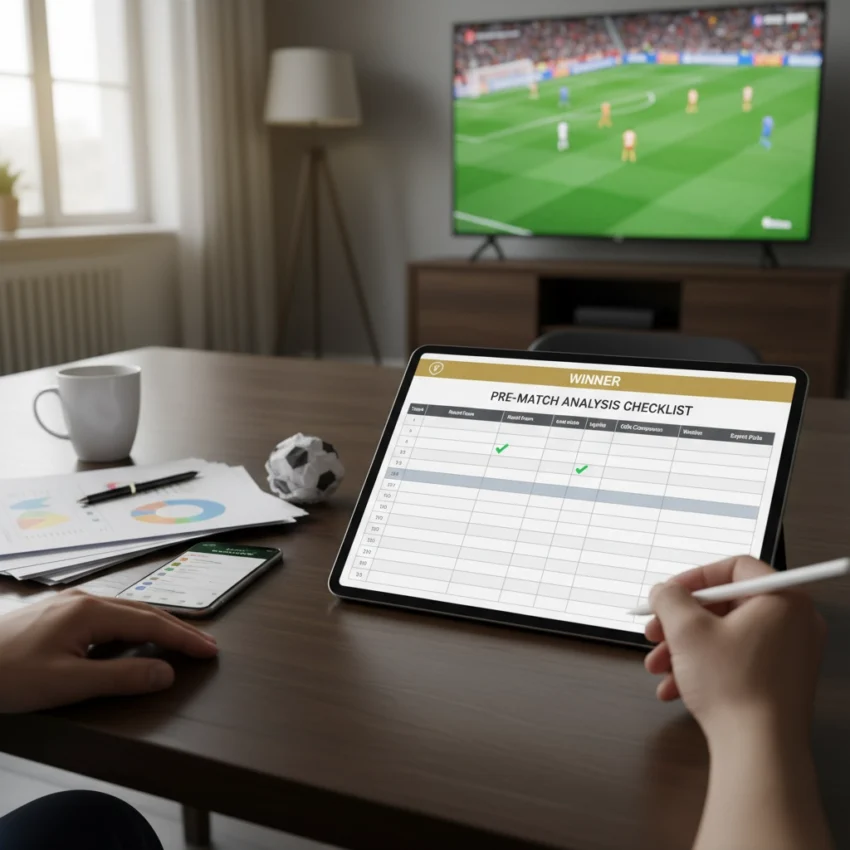
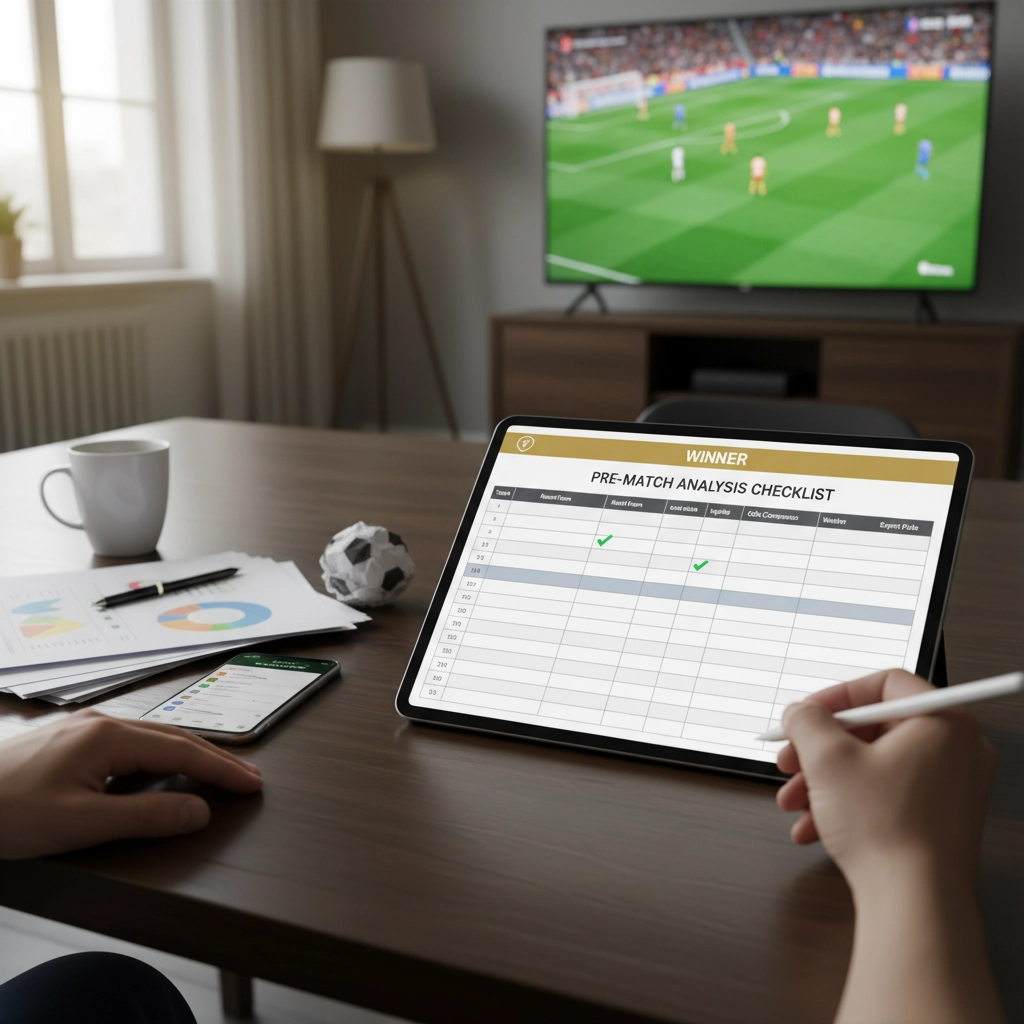
Preparing to pick a winner: why disciplined pre-match analysis matters
Before you bet on a match winner, you need a repeatable process that reduces guesswork and emotional decisions. You’re competing not only with the teams on the pitch but with the market and your own biases. A solid pre-match checklist helps you identify value, manage risk, and decide whether the bookmaker’s prices match the true probabilities.
Use this checklist as a practical routine. It should take you 10–30 minutes per match depending on the level of detail you want. Focus on information that directly affects a team’s chance of winning: current form, squad availability, tactical matchups, context (motivation and scheduling), and the basic statistical signals that reveal sustainable performance versus lucky results.
Core steps to complete before you commit a stake
- Set a clear bet objective: Decide if you’re hunting for outright winners, value bets, or hedges. Your objective determines how tightly you apply the checklist.
- Check recent form: Look at the last 5–8 matches for trends in wins, draws and losses. Prioritize underlying performance (goal difference, chances created) over raw results.
- Review squad availability: Identify injuries, suspensions and late fitness doubts. Missing a key striker or centre-back changes probability more than losing a rotation player.
- Understand tactical matchup: Consider playing styles—does Team A’s high press exploit Team B’s weak build-up? Matchups can invert expectations even when one side looks stronger on paper.
- Assess context and motivation: Note fixture congestion, travel, cup priorities, relegation battles or tactical resting for other competitions. Motivation often swings outcomes in tight matches.
Practical indicators and quick metrics to prioritize
- Expected goals (xG): Compare each side’s xG on attack and conceded. Consistently outperforming or underperforming xG flags potential regression.
- Shot volume and quality: Teams that generate high-quality chances are more likely to sustain wins than teams that rely on long-range luck.
- Set-piece influence: If either team scores or concedes a disproportionate share from set pieces, factor that into matchup decisions.
- Home advantage and travel: Home form, ground-specific records and travel fatigue (especially midweek European games) change probabilities.
- Head-to-head nuances: Recent H2H results, managerial history and psychological edges can matter—especially when teams meet frequently.
As you apply these checks, keep a simple scoring or weighting system so you can compare matches objectively rather than relying on gut feeling. In the next section, you’ll learn how to translate your checklist findings into a betting decision by evaluating market odds, calculating implied probabilities, and spotting value opportunities.
Turning your analysis into market value: reading odds and finding an edge
Once you’ve completed the checklist and formed an independent probability for each outcome, the next step is to compare that view to the market. That’s where value — not certainty — determines long‑term profit.
– Convert odds to implied probability. For decimal odds, implied probability = 1 / odds. A 2.50 price implies 40%. If your analysis gives that outcome a 45% chance, you’ve identified a 5 percentage‑point edge.
– Account for the bookmaker margin. Markets rarely sum to 100%; the excess is the vig. If the market’s implied probabilities add to 110%, normalize each price by dividing its implied probability by 1.10 to estimate the bookmaker‑adjusted market probability. Use that adjusted figure when comparing to your own.
– Look for sustainable edges. A small edge on a single game can still be valuable if it’s based on durable information (injury news, tactical mismatch, strong xG backing). Avoid edges that rely on short‑term variance (a team on three lucky wins with weak underlying numbers).
– Prioritize where your model is most different from the market. You won’t find edges every match. Focus your time where your process identifies a clear discrepancy: unusual starting XI, recent tactical change, or travel and rest differentials that the market may have underpriced.
– Use multiple sources. Line shopping across bookmakers and exchanges is crucial. The best price often determines whether an identified edge is actually exploitable. Don’t assume the first published number is the fairest.
Keep this comparison succinct: implied probability, adjusted for vig, versus your probability estimate. The difference (if positive and repeatable) is the value you can stake on.
Staking, timing and discipline: converting value into a long‑term plan
Finding value is only half the job. How much to stake, when to place the bet, and how you manage your bankroll turn value into results.
– Staking plan first. Use a consistent staking model. Flat stakes are simple and reduce emotional swings. Percentage stakes (1–5% of bankroll) scale with your equity. Kelly is mathematically optimal but volatile; use a fractional Kelly (10–25% of full Kelly) if you prefer responsiveness without extreme variance.
– Size to edge and confidence. If you’re adding subjective weight (e.g., high confidence in a key player’s return), adjust stakes modestly, but avoid large, impulsive bets. The stake should reflect both edge size and your certainty in the analysis.
– Time your entry. Early lines can offer value when public information hasn’t been priced in, but they carry risk if late news (team list, weather) reverses the edge. Conversely, waiting can let sharper money correct soft lines. Decide case-by-case: if your edge relies on public information that will be widely known pre‑match, act early; if it depends on manager decisions or late fitness, wait until the lineup is confirmed.
– Shop and manage liquidity. Use multiple bookmakers and, where available, exchanges. For larger stakes, confirm market liquidity to avoid moving the price against yourself.
– Track, review, repeat. Log every bet: stake, odds, reason, and result. Periodic review reveals which parts of your checklist reliably produce value and which are noise. Enforce bankroll rules: set loss limits, avoid chasing, and never increase stakes after a losing run without a disciplined reason.
A repeatable, documented approach — assessing odds, adjusting for vig, staking by edge, and timing your entry — turns individual insights into a sustainable betting process.
- Quick pre‑match actions: convert published odds to implied probabilities, normalize for the bookmaker margin, and compare the adjusted market probability to your independent estimate.
- Confirm late information: check the starting XI, injury reports, weather, and any travel/rest anomalies that could change your edge.
- Decide on timing: place bets early when the information is stable and unlikely to change, or wait for confirmation if your edge depends on late fitness or manager selection.
- Line shop and confirm liquidity: compare prices across bookmakers and exchanges to ensure the edge is actually exploitable at the stake you intend.
- Record and review: log rationale, stake, odds, and outcome. Use periodic review to refine which checklist items produce repeatable value.
Putting analysis into practice
Betting well is less about finding the perfect prediction and more about doing a few simple things consistently: protect your bankroll, act only on repeatable edges, and treat each wager as an experiment you can learn from. Maintain discipline when results go against you, and be prepared to adapt your process as the market and your information sources evolve. If you need guidance on safer play, consult reputable resources such as GambleAware.
Frequently Asked Questions
How do I convert decimal odds into implied probability?
For decimal odds, implied probability = 1 / odds. For example, decimal odds of 2.50 imply a 40% chance (1 ÷ 2.50 = 0.40). Use that as the starting point when comparing the market to your own probability estimate.
What is the bookmaker margin and how should I adjust for it?
The bookmaker margin (vig) is the excess of the market’s implied probabilities over 100%. If the sum of implied probabilities is 110%, divide each implied probability by 1.10 to normalize them (e.g., a raw 44% becomes 44% ÷ 1.10 = 40%). Compare your estimate to these normalized figures to assess value.
Which staking method is best when I find an edge?
Choose a staking plan that matches your risk tolerance: flat stakes for simplicity, percentage stakes (1–5%) to scale with bankroll, or fractional Kelly (10–25% of full Kelly) for a balance of growth and volatility. Size bets to both the edge and your confidence, and avoid impulsive increases after losses.