
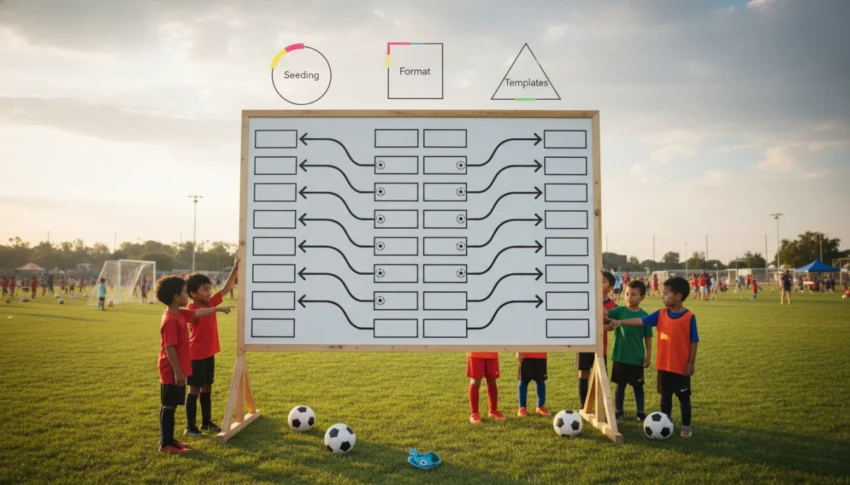
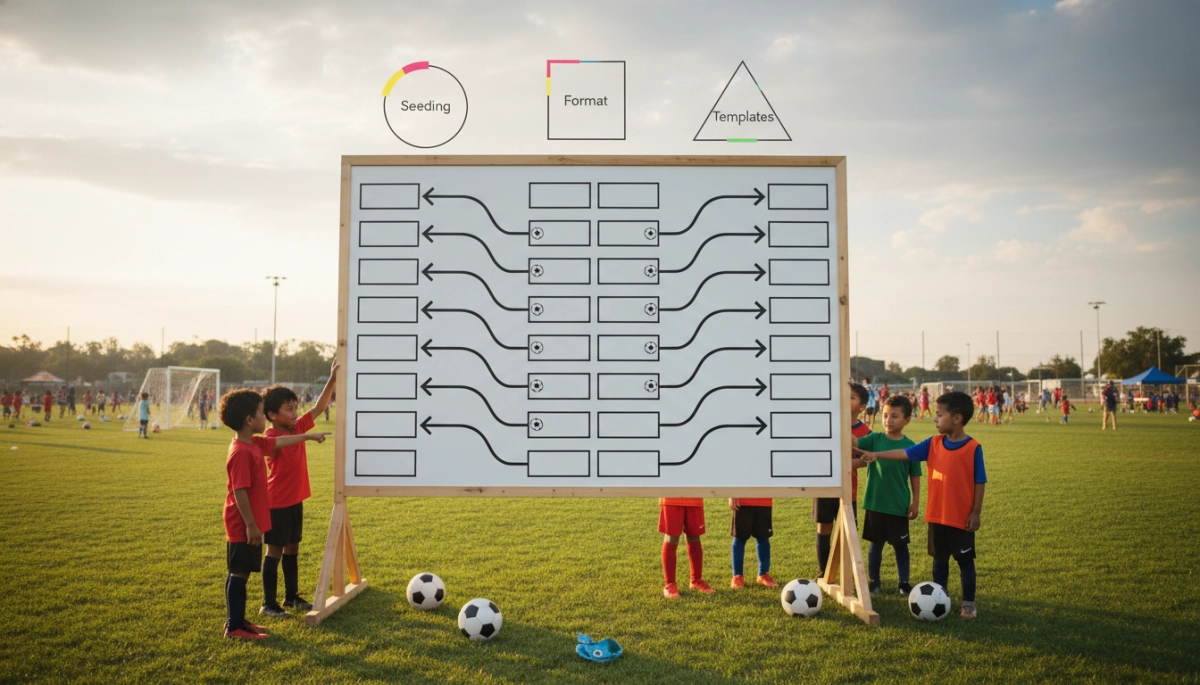
Why well-designed brackets matter for youth soccer tournaments
You organize or help run youth soccer tournaments to give kids fun, fair competition and to keep logistics manageable. The bracket you choose affects playing time, travel needs, referee scheduling, and how teams perceive fairness. A poorly chosen format can leave teams waiting for long periods, create uneven matchups, or require mid-tournament changes that frustrate coaches and parents. By understanding basic formats and seeding principles up front, you reduce on-site headaches and give everyone a better experience.
This part of the guide covers common bracket structures you’ll encounter and the core seeding principles that keep results credible. You’ll learn the trade-offs between elimination and pool play, how to handle odd numbers of teams, and quick checks to make sure the schedule fits your fields and time window. Later, you’ll get ready-made templates and step-by-step instructions to build brackets for different age groups and timeframes.
Common bracket formats and when to use each
Not all tournaments need the same bracket. Choose a format based on number of teams, available fields, desired number of matches per team, and level balance.
- Single-elimination: Best for small tournaments with limited time. Teams are out after one loss, so you need fewer matches and can finish quickly. Use consolation semifinals if you want extra guaranteed games.
- Double-elimination: Gives teams a second chance after one loss. It’s fairer for competitive play but requires more fields/time because of the losers’ bracket.
- Round-robin (pool play): Ideal when you want every team to play multiple games. Pools of 4 are common; top teams can advance to knockout rounds. This format maximizes playing time but needs careful scheduling to avoid conflicts.
- Swiss or group + knockout hybrids: Useful for medium-sized events where you want balanced matchups without full round-robin hours. Teams play a set number of rounds against similarly performing teams, then advance to elimination brackets.
Practical constraints that shape your choice
- Field availability — fewer fields push you toward single-elimination or shortened pool sizes.
- Time per match — younger age groups play shorter games; that affects how many rounds fit in a day.
- Guaranteed games — parents and coaches often expect a minimum number of matches for travel tournaments.
- Referee availability — more matches require more officials or longer shifts; factor costs and rest periods.
Seeding fundamentals to keep competition fair
Seeding determines initial matchups and strongly influences perceived fairness. You can seed by past results, coach rankings, age-group divisions, or a random draw when you lack reliable data. The goals are to avoid stacking strong teams early, minimize same-club matchups in the first round, and give all teams a clear path to placement games.
- Use rankings or past tournament performance when available for the top seeds.
- Mix teams from the same club across different pools to avoid early eliminations within a single club.
- When seeding is unknown, a transparent random draw reduces disputes; publish the method ahead of time.
With bracket types and seeding principles in place, you’re ready to apply those choices to specific schedules and printable templates — next you’ll find step-by-step templates for 8-, 12-, and 16-team tournaments and tips for customizing them to your time and field limits.
Step-by-step bracket templates: 8-, 12- and 16-team setups
Below are practical, ready-to-apply bracket blueprints. Use the seeding guidance from earlier to place teams into these slots.
– 8-team single-elimination (fast, clean)
– Quarterfinals: 1 vs 8, 4 vs 5, 3 vs 6, 2 vs 7.
– Semifinals: Winner(1v8) vs Winner(4v5); Winner(3v6) vs Winner(2v7).
– Final + 3rd-place match (optional). This format needs 7 matches (or 8 with a 3rd-place game).
– 12-team options (choose by time/guaranteed games)
– Single-elim with byes: Seed top 4 directly to quarterfinals. Round of 12: 5 vs 12, 6 vs 11, 7 vs 10, 8 vs 9. Winners meet seeds 1–4. Useful when you must finish quickly but want some reward for top seeds.
– Pool + knockout (recommended for guaranteed play): 3 pools of 4 teams. Each team plays 3 pool games; advance top team from each pool plus the best runner-up(s) to make a 4- or 8-team knockout (commonly top 2 from each pool plus two best third-place for an 8-team bracket).
– 16-team single-elimination (standard, balanced)
– First round: 1 vs 16, 8 vs 9, 5 vs 12, 4 vs 13, 3 vs 14, 6 vs 11, 7 vs 10, 2 vs 15.
– Follow with quarters, semis, final. Add consolation bracket for teams knocked out in round one if you need guaranteed minimum matches (example: consolation semis and final = two extra matches for losing teams).
For consolation/guaranteed-play: convert the first-round losers into a consolation bracket (single- or double-elim) so each team gets at least 2–3 matches. Label all placement games clearly on your schedule to avoid no-shows and confusion.
Customizing brackets for time, fields and odd team counts
Practical tweaks make brackets fit real-world constraints.
– Match lengths and turnover
– Typical match time guidelines: U8 ~30–40 minutes total, U10 ~40–50, U12 ~50–60, U14+ ~60–80. Always include 10–15 minutes between matches for warmups, field turnover, and referee transition.
– Use staggered start times on multiple fields to reduce crowding and allow referees to move between games.
– Scheduling by field availability
– Calculate total match slots = available hours × number of fields ÷ (match length + turnover). Work backward to pick a format that fits (e.g., two fields for 7 hours with 50-minute slots = ~16 match slots).
– If slots are tight, prefer single-elimination or reduce pool sizes.
– Handling odd numbers of teams
– Add a play-in match(s) to reduce to a bracket-friendly number (e.g., 9 teams → one play-in to make 8).
– Or use pools of three (each team guaranteed 2 games) and advance top performers to elimination rounds. Pools of three work especially well when you can’t add a team or provide byes.
– Referee and rest considerations
– Avoid scheduling a team for back-to-back games whenever possible.
– Aim for at least one full match-length break between games for players and a referee rotation plan so officials get rest.
Small adjustments—byes, short consolation pools, or compressed match lengths for younger ages—let you preserve fairness while fitting your fields and time window. In Part 3 you’ll get printable templates and step-by-step bracket-building worksheets you can copy into a spreadsheet.
Putting it into play
With a format chosen and seeds set, move from planning to execution: finalize field assignments and match times, publish the bracket and rules to coaches and referees, and run a short check-in before the first whistle to confirm pairings and logistics. Treat your first event using a new bracket as a pilot—collect feedback from coaches, referees, and volunteers, then tweak match lengths, start windows, or consolation structure for future events. For templates, scheduling worksheets, and additional organizer guidance, see U.S. Youth Soccer resources.
Key Takeaways
- Match the bracket format to your time, fields, and goals—prioritize guaranteed games for travel tournaments and speed for limited-time events.
- Seed transparently to reduce disputes: use rankings when available, mix club teams across pools, or run a published random draw.
- Plan for logistics early—calculate match slots, stagger starts, avoid back-to-back games, and provide a simple consolation plan for guaranteed play.