
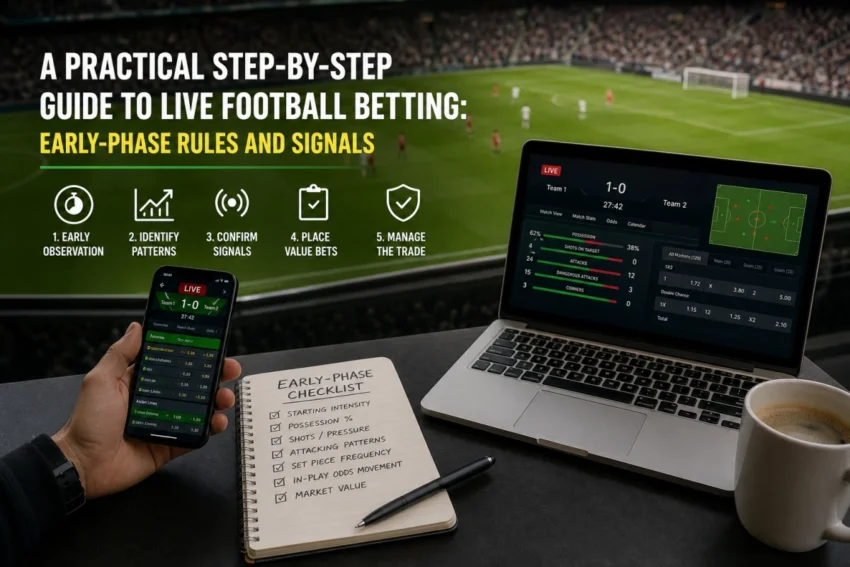
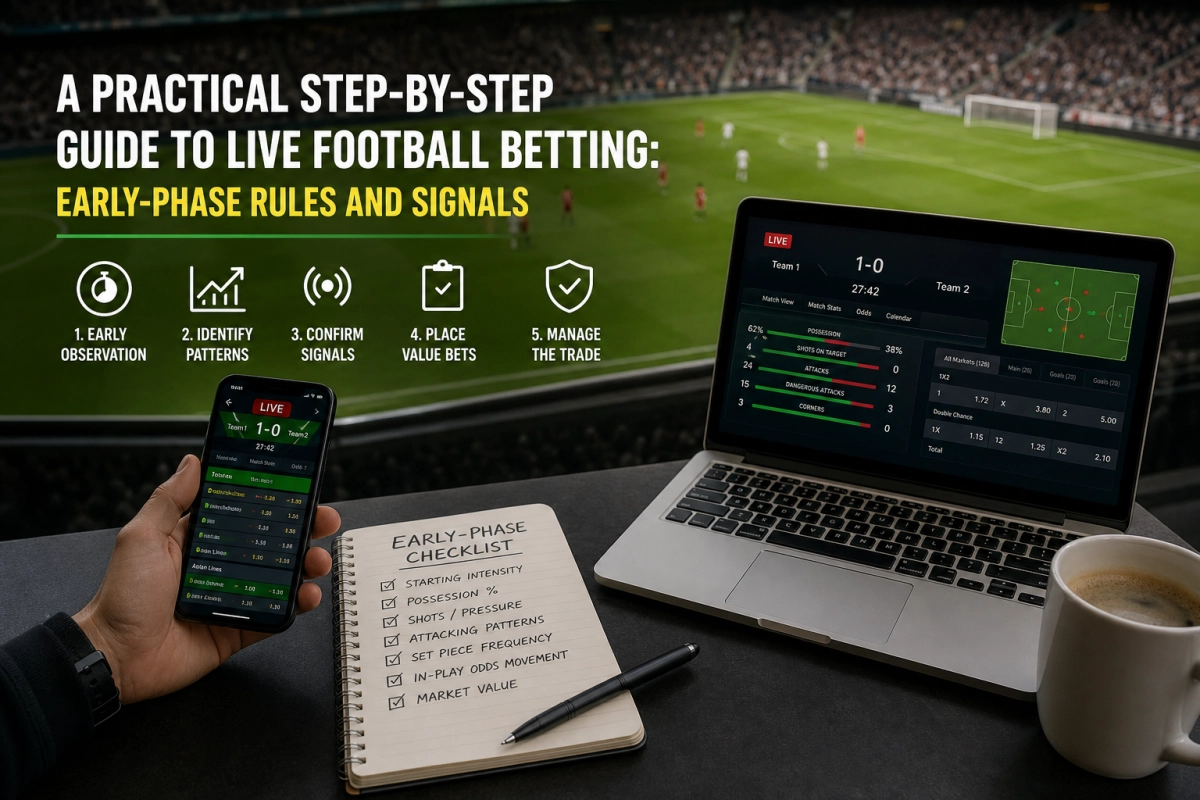
Why divide a match into phases for live football betting?
Treating a match as early, middle and late phases makes live betting manageable: each phase has different dynamics — teams open up or consolidate, substitutions and tactical changes appear, and statistics (possession, shots, xG) evolve. This guide gives concise, practical rules for each phase so bettors can make measured in-play decisions instead of guessing on first impressions.
Early-match decision rules: which markets to target and why
The early phase (kick-off to ~20–25′) requires markets that react quickly to clear trends. Avoid markets that need long observation.
Best early markets (what they are and when to use them)
- Over/Under goals — back unders (e.g., under 2.5) if both teams start cautiously; back small overs (over 0.5/1.5) if there is immediate attacking intent.
- Both Teams To Score (BTTS) — use if both sides create chances early; avoid if one team dominates possession and limits the opponent.
- Asian Handicap — capture value on a stronger side starting fast (e.g., -0.25/-0.5); preferable to straight match-winner where draws are likely.
- Corners — early corner sequences often indicate sustained pressure; useful when one side wins multiple corners in opening minutes.
- Cards — only small stakes: increased fouls, a physical derby or an early yellow can make these markets attractive but volatile.
Live stats and signals to monitor in the opening 20 minutes
- Possession and entries into the final third — who repeatedly enters attacking areas.
- Shots and shots on target — early danger is signalled by attempts on goal, not just possession.
- Cumulative xG — shows chance quality versus quantity.
- Pressure events and set-piece frequency — important for over/BTTS and corner markets.
- Early substitutions or injuries — these can shift momentum and prices quickly.
Concrete staking and basic hedging rules for the early phase
- Unit sizing: small stakes (1–2% of bankroll) because noise is high.
- Predefine maximum loss per match/phase (e.g., 3–5% in early phase).
- Hedge: if a bet moves strongly in your favour take partial cash-out or place a small counter-bet to lock profit; size hedges so worst-case fits bankroll rules.
- Avoid increasing stakes in first 15 minutes unless signals are clear (xG spike, several shots on target).
Understanding odds movement and streaming latency is essential before placing in-play bets; the next section explains how to read live odds, detect value when lines change, and protect against delays between broadcast and bookmaker feeds.
Reading live odds, detecting value and handling streaming latency
Live odds summarise market probability and should be read as signals, not noise. Always factor in the latency between what you see and the bookmaker feed.
- Interpret odds moves: a steady drift against a selection typically reflects opponent dominance or worsening xG; rapid shortening follows clear attacks, big chances or a sending-off. Confirm moves with stats — odds moves without xG/shot/possession changes are often noise.
- Latency checks: measure your delay by timing how long visible events (shot, yellow card) take to affect odds. Broadcasters can be 5–30+ seconds behind; if delay >5s avoid “first-second” reaction bets. Use low-latency sources (exchange feeds, bookmaker APIs or dedicated streams) when possible.
- Order types: use limit bets for specific prices and market/accept when acting on a rapid, well-confirmed signal. Prefer partial cash-outs or counter-bets to lock profit when liquidity makes perfect hedges impractical.
- Simple hedging formula (full hedge): lay_stake = (back_stake * (back_odds – 1)) / (lay_odds – 1). Full hedges often need large lay stakes; partial hedges or cash-outs are usually more practical.
Middle-match decision rules (25’–70′): markets to target, signals to trust and staking escalation
The middle phase is where patterns solidify. Bet more confidently than in the early phase, but require multiple confirmations and maintain discipline.
- Over/Under — back overs when cumulative xG and recent shots indicate sustained chance creation; favour unders if xG stagnates and possession is non-threatening.
- BTTS — target when both teams have meaningful xG and clear chances; avoid if one side is ultra-defensive.
- Asian Handicap — use when a favourite begins to dominate (e.g., xG delta >0.5); upgrade to steeper lines only with sustained dominance or a red card.
- Corners — play on sequences (e.g., 3–4 corners in 10 minutes) or when a side is creating repeated wide attacks.
- Cards — increase only with referee card-rate evidence plus game context (derby, visible frustration).
Live stats trigger checklist (require 2+ confirmations)
- xG delta over last 20 minutes, shots on target, entries into the final third, big chances, goalkeeper activity, and tactical substitutions.
- Example rule: back Over 2.5 only if cumulative xG >1.2, 4+ shots with 2 on target in last 30′, and both teams still attacking.
Staking and hedging rules for the middle phase
- Increase stakes modestly to 2–3% of bankroll for high-confidence setups; never exceed per-match caps (e.g., 8–10% total risk).
- Hedge or cash-out when a position has realised 40–60% of its projected profit; use full-hedge formula only if liquidity supports it.
- If odds move against you after a confirmed signal, reduce exposure rather than doubling down; set stop-loss per market (e.g., close at 50–75% of initial stake).
Late-match decision rules (70’–90+): what to trade and how
Markets to prioritise in the closing phase
- Next-goal / Anytime goal — valuable when a team is visibly dominating; best with exchange liquidity or low-latency prices.
- Over/Under short-lines (0.5, 1.5) — over 0.5 for teams piling on pressure; under 0.5 to lock value when match is settled.
- Asian Handicap/Match-winner — target favourites when dominance is sustained, or back the chasing team on +AH if momentum truly shifts.
- Corners — trailing teams often generate late corner sequences; corners can be more predictable than goals in routable patterns.
- Cards — late frustrations create opportunities but remain high-variance; stake small.
Live signals to trust in the final 20 minutes
- Sustained pressure: repeated final-third entries, multiple shots or blocked shots, clear xG/min uptick.
- Attacking substitutions or tactical shifts to high press — treat visible formation change as a strong signal.
- Goalkeeper activity and defensive errors — frequent saves or poor clearances raise goal probability.
- Score and time context — consider whether the trailing team must take risks or is content to protect a result.
Staking and hedging rules for the late phase
- Increase stakes only with high-confidence, multi-signal setups (typical late bets 1.5–4% of bankroll), respecting per-match caps.
- Three-confirmation rule: require at least three independent signals (e.g., substitution + repeated shots + xG spike) before upping stake above baseline.
- Prefer partial hedging — lock a portion (for example, 50%) of unrealised profit with staggered lays or cash-outs rather than attempting risky full hedges.
- Pre-place limit orders on next-goal markets where possible to avoid latency issues; define stop-loss rules for adverse moves.
Handling stoppage time and sudden events
- Stoppage time is highly volatile: only enter if you have a clear edge and minimal latency; exchanges with depth and lay ability are preferred.
- After a red card or injury wait for the referee’s restart and one subsequent sequence before betting; immediate moves are often overreactions.
- If odds move due to an event you didn’t see, confirm with a reliable feed before reacting.
Responsible risk controls, record-keeping and continuous improvement
Bankroll and exposure rules
- Staking as percentages: define a base unit (commonly 1% of bankroll) and size stakes relative to it across phases.
- Per-match caps: set a maximum percent risk per match (e.g., 8–10%) and enforce mechanically.
- Loss limits and cool-off periods: impose daily/weekly loss ceilings and mandatory breaks after losing sequences to avoid tilt.
Operational controls
- Latency guardrails: avoid split-second markets if measured feed delay exceeds your tolerance (commonly 2–5s max).
- Liquidity checks: verify market depth before large hedges; in thin markets plan smaller partial hedges or accept greater variance.
- Predefine rules for streaming outages, app failures or bookmaker refusals — have a fallback exchange and an emergency stop-bet rule.
Record-keeping and review
- Keep a journal with date, league, minute, market, stake, odds in/out, live stats at entry, reason for trade and outcome.
- Review weekly: compute ROI by market, phase and signal combo; cut or refine strategies that show persistent negative expectancy.
- Backtest rules on historical event streams or simulated feeds before scaling stakes live.
Behavioural and ethical boundaries
- Never chase losses; enforce stop-loss limits and cooling periods.
- Do not bet under emotional distress, fatigue or intoxication — your rules depend on discipline.
- Use responsible gambling tools (limits, self-exclusion) if control weakens.
Maintaining discipline and developing skill over time
Good live trading is as much about temperament and process as it is about rules. Treat each match as a set of testable hypotheses: apply the phase rules consistently, log outcomes, and iterate. Prioritise low-variance, repeatable edges and protect your bankroll. Expect losing runs; plan for them. With disciplined record-keeping, latency awareness and strict exposure controls you can reduce randomness and improve decision quality — and that is where consistent, long-term progress comes from.